

March 25, 2026
·
When you meet Anna Diehr, founder of Anna Valloire, it becomes clear quickly: this is not a brand built around trends. Rooted in Germany, Anna Valloire is built on a conviction that fashion should last, that you should know the people who make your pieces, and that the materials you choose tell a story. We sat down with Anna to talk about how she discovered Leap®, what made it the right fit, and what she believes the future of responsible fashion looks like.
You founded Anna Valloire with a clear commitment to sustainability and regional production. Why was that non-negotiable from the very beginning?
Anna Valloire was never just a brand to me. It was the urge to close a gap that had bothered me for a long time: how do you reconcile genuine aesthetic ambition with a clear conscience? From day one, regional production was non-negotiable. Not because it's a trend, but because I want to know the people who make my pieces. In a world that's getting faster and more anonymous, that knowledge feels like the real luxury.
Honestly, I couldn't run this brand if I knew we were wasting resources just to grow. For me, fashion only makes sense as something that lasts, not something you consume for a season and throw away.
As a young brand, you don't produce yourself but work with selected regional partners. How do you make sure your sustainability vision actually shows up in production?
The people I work with are the real foundation of my brand. I look for manufacturers where I can feel they share the same passion for genuine craft. Regional production means I can actually understand the supply chain, and that trust is something no certification in the world can replace. I want to work with people who care about using resources responsibly as much as I do. My vision is only as strong as the integrity of the people bringing my designs to life.
When you choose a material, what criteria matter most: aesthetics, performance, origin, footprint, or scalability?
Quality and ethics always come before volume. That's non-negotiable. Before a material becomes part of Anna Valloire, I have to know its full story and stand behind its origins completely. Carbon footprint matters to me too, it's a useful compass for making responsibility measurable. But ultimately, the most honest form of sustainability is simply longevity: how long can a piece actually accompany you?
Scalability barely enters my thinking. I didn't found Anna Valloire to flood the market. If a material is perfectly scalable but leaves questions around origin or quality, it doesn't make the cut. It has to feel right, both in my hands and in my conscience.
What made Leap® interesting compared to other next-gen materials on the market?
What convinced me most was the logic of it. Why deal with complex supply chains when we can use high-quality apple residues from juice and cider production right here in Germany and Europe? That regional availability and the transparency it brings are decisive factors for me.
What sets Leap® apart is their consistent execution of "Make Waste Beautiful." It's remarkable to see how they've reframed waste as a valuable resource, without compromising on aesthetic quality or durability. That approach aligns exactly with my own vision of a circular economy.
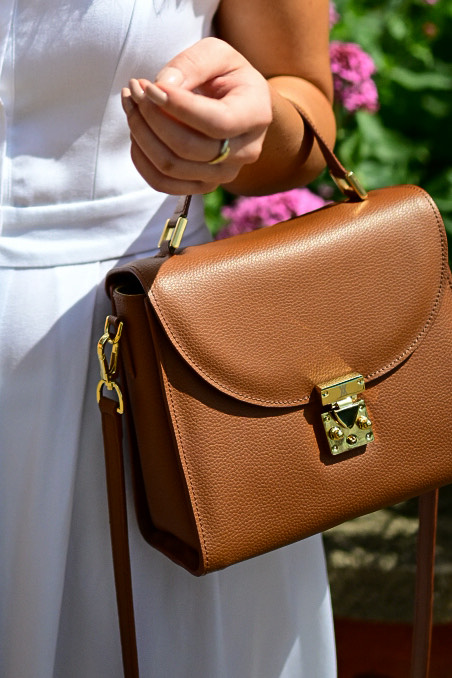
Choosing an innovative material as a startup can feel risky. Did you hesitate, or did it feel aligned immediately?
Of course there's risk involved when a startup bets on a new material. I weighed it up, but I didn't hesitate for long. What tipped the balance was the direct relationship with Mikael, Beyond Leather's founder. His transparency and willingness to help from the very start gave me real confidence. For me, that kind of calculated risk is just part of building something. If you want to change things, you have to be willing to do things differently.
How did your production partners react to working with Leap®?
They reacted positively because they could immediately see the potential. Since it's a material that's still being developed further, working with it in practice was an interesting challenge for them. That openness let us gather genuinely valuable insights and move the process forward together.
How do you balance aesthetic ambition with responsible sourcing?
For me, it's more important than ever to bring timeless aesthetics back to the center. In an industry defined by constant change, I consciously prioritize permanence over short-lived trends. This is exactly where aesthetic ambition and responsible sourcing align: a product is only truly timeless when both the design and the origin of the materials can stand the test of time.
How do your customers respond when they learn that your pieces are made with Leap®?
The reactions are consistently positive, often genuinely enthusiastic. The first questions are always: leather from apples? That exists? People are surprised when they hear it's animal-free and made from apple residues and other bio-based materials. But the moment they touch it and see how close it is to traditional leather, any remaining doubts disappear.
What my customers value most is the ethical dimension: knowing no animal suffered for their product makes the value feel real to them. It's wonderful to watch skepticism turn into enthusiasm the moment they realize there's no compromise on aesthetics or feel.
.JPG)
As your brand grows, how do you see next-generation materials shaping your future collections?
For me, there's really no other option: next-generation materials are 100% a given. Not a choice, a foundation. Many brands lose sight of their principles as they scale, and that's exactly what I refuse to let happen with Anna Valloire.
Growth shouldn't change anything. If anything, it deepens my commitment. I want to prove that you can stay true to your values even with more volume. When someone picks up a piece of Anna Valloire in the future, I want them to feel that it was made with conviction, and with materials that mean something. That's my promise to myself, and there are no exceptions.
Curious to see how Leap® performs in fashion applications? Request a sample and experience it for yourself.
.svg)
.svg)
